|
|
|
|
|
|
|
||||
|
|
|
|
|
|
|||||
|
|
|||||||||
|
Rediscovering by
Peter H. Michael |
|||||||||
|
|
|||||||||
|
Rediscovering by Peter H. Michael |
|
|
|
|
|
||||
|
|
|
|
|
|
|||||
|
|
|||||||||
|
Contents Legacy of Conscience: The
Underground Railroad The 280-Year North American
Heritage Rating the Authenticity of
Underground Railroad Sites The Shrouded Nature of the
Underground Railroad Information Sources on
Frederick County Underground Railroad Sites Sites Documented By Written
Records Underground Railroad
Safe-Houses and Routes in Frederick County Map of Frederick County,
Maryland Underground Railroad Major Underground Railroad
Sites Near Frederick County Maryland Local Tours of the
Underground Railroad Gettysburg, Pennsylvania to
Waterford, Virginia Further Exploring the
Underground Railroad Underground Railroad Free Press References |
|||||||||
|
Rediscovering by
Peter H. Michael |
|
|
|
|
|
||||
|
|
|||||||||
|
Synopsis Some regard the Underground Railroad as the noblest endeavor
of conscience in United States history.
The Underground Railroad existed for 280 years - more than a quarter
of a millennium - from 1585 when the first enslaved people from Africa
arrived in the New World at the Spanish settlement of Saint Augustine,
Florida, to the end of the Civil War in 1865. The inception of the
Underground Railroad, though it would not have a name for another 250 years,
would have been when an enslaved person first escaped from the Saint
Augustine colony and was aided by any other person, most likely a Native
American. For 280 years, every American - black, white and Native
American - was aware of the institution of slavery, that every enslaved
person wanted to be free, that some would risk life and limb to seek their
freedom, and that some free people - black, white and Native American - would
risk all to aid freedom seekers in their quest. All Americans and Canadians were
acutely aware of these things which therefore formed a deeply rooted part of
the very consciousness of the two nations and a tightly woven strand of the
fabric of daily life. Thus, the
long contest between freedom and slavery, between good and evil in North
America, was, as author Fergus Bordewich puts it, the war for the soul of
America. Indeed it was. It took 280 years - a very, very long
time - to win this war, but won it was.
The moral certitude, perseverance and courage of Underground Railroad
safe-house operators and conductors, but most especially of freedom seekers
themselves, delivered the continent from its moral failing and darkness. When Harriet Tubman, the last living major figure of the
Underground Railroad, died in 1913, interest in the Underground Railroad,
which still ran high, began to wane.
Other than a slight resurgence in the 1930s, the memory of the Underground
Railroad began to slip from the national consciousness until by the
mid-twentieth century many American adults either had not heard of the
Underground Railroad at all or, among the few who had, sometimes actually
took the name literally as a kind of subterranean conveyance for fugitives. What remains today through the oral traditions of handed-down
accounts and, in many fewer cases, actual documentation almost entirely from
northern states is precious and dwindling as oral traditions continue to die
out with the passing of Underground Railroad site owners and the descendants
of freedom seekers, safe-house operators and conductors. Thus, it is vital to record and
preserve intact Underground Railroad stories while they remain with us and to
assure that they are not pushed to dusty back shelves to be forgotten by too
much emphasis on the very small fraction of Underground Railroad history and
sites fortunate enough to be documented.
The purpose of Guide to Freedom
is to reveal and preserve for posterity the collection of these stories from
one United States county, Frederick County, Maryland, which found itself at
the crossroads of the national argument over slavery, the Civil War and the
Underground Railroad. Routes east of the Appalachians are not well documented until
one gets north of the Mason-Dixon Line and into Pennsylvania, the first free
state which freedom seekers encountered until November 1, 1864, when Maryland
abolished slavery. Frederick County sits directly amidst a fifty-mile swath
between southern Maryland to the east which had strong pro-slavery views and
the Appalachians to the west where the terrain made flights to freedom more
difficult. This fifty-mile
stretch of friendlier, easier-to-negotiate territory funneled freedom seekers
through Frederick County, the neighboring Montgomery and Washington Counties
of Maryland and Washington, DC.
Frederick County sits at the center of this funnel. Frederick County, a border county in a border state, had
distinctly split sympathies regarding abolition and slavery with the
predictable result of virtually all of its Underground Railroad sites being
clandestine at the time and therefore remaining very shrouded, if not
altogether forgotten, until recent research. Guide to Freedom reveals the Underground Railroad in Frederick
County where author Peter Michael resides and has been uncovering the
safe-houses, routes and personages of the Underground Railroad intensively
for the past seven years. As of 2008, sixty-one confirmed or suspected Underground
Railroad sites have been identified in Frederick County, beginning to flesh
out the picture of what the Underground Railroad in the county looked and
felt like in its time. With the
renewed enthusiasm for the Underground Railroad, stories in Frederick County
are beginning to surface more and more often and the list of possible sites
grows. Even as it was in its day,
we can never be certain whether some sites said to have been involved in the
Underground Railroad in this county, as elsewhere, actually were involved,
and this ambiguity reflects the very nature of the Underground Railroad in
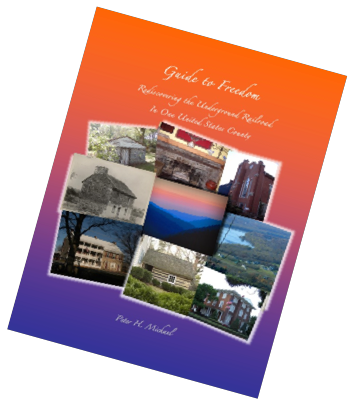
its time. Guide to
Freedom: Rediscovering the Underground Railroad In One United States County reveals much of the
recently rediscovered Underground Railroad life of Frederick County,
Maryland, a major conduit for freedom seekers between the slave state of
Virginia and the free state of Pennsylvania, both adjoining the county. Despite Frederick County's geographic
importance to the Underground Railroad, most of its fascinating Underground
Railroad history had nearly been lost to time. With the aid of local historians and
others who came forth with documentation and their remembered oral
traditions, Peter Michael's Guide to
Freedom presents one of the very few detailed pictures of the Underground
Railroad in any border or southern state. Guide to
Freedom
lists all confirmed or suspected Underground Railroad safe-houses and routes
in this one United States county and rates each according to the likelihood
that its oral tradition or documentation is authentic. Many of the book's site listings are
accompanied by photographs of the safe-house or route. What emerges is a network of six
confirmed routes, more than fifty confirmed or suspected safe-houses, and
nearly twenty Underground Railroad freedom seekers, safe-house operators and
conductors. Of high interest to
readers will be the stories of individual freedom seekers identified by name
who passed through Frederick County including several who were sheltered in
the still-existing stone spring house at the author's Cooling Springs Farm. Moving beyond Frederick County, Guide to Freedom details seven nearby Underground Railroad sites
of prime national importance including the original Uncle Tom's cabin,
provides directions for several road tours, and offers guidance for further
Underground Railroad reading and exploration. Aside from being fascinating reading, Guide to Freedom shows the way for
others wanting to reveal the Underground Railroad histories of their own
locales and serves as an excellent text for students from middle school
through college. |
|||||||||
|
Rediscovering
|
|
|
|
|
|
||||
|
|
|||||||||
|
Purchase Guide to Freedom Guide to
Freedom: Rediscovering the Underground Railroad In One United States County may be ordered on line at
Amazon.com or through your favorite bookstore. Click here to order from Amazon.com. Other Books By Peter H. Michael An American Family of the Underground
Railroad A very readable and heavily documented history of the
involvement by the author's ancestors in the Underground Railroad and the
family's later fights for racial justice in the United States during the
twentieth century. In a rare
account, the book sheds light on one of the most courageous and now famous
escapes of the Underground Railroad and its direct conjunction with the
author's family then and today. Click here to order from Amazon.com. Running on Empty: Along an Epic 12,000-Mile
Road Trip America Has Its Say on Economic Inequality Winner of a national book prize in political and economic
affairs and another in travel essays. Michael recounts his classic
12,000-mile road trip taking in the expansive variety of people and places of
the United States. Michael set out not to fathom the country "in search
of America" as Steinbeck, Kerouac and Least Heat-Moon had but to listen
and let America tell him whatever it might, in this case economic disparity. Click here to
order from Amazon.com. Remembering John Hanson: A Biography of the First President of
the Original United States Government Winner of two 2013 national book awards in biography. Remembering
John Hanson re-illuminates the key Revolutionary War figure and Founding
Father to whom George Washington reported when Hanson served as the first
president of the original United States government chartered under the
Articles of Confederation. This Hanson biography, the first in over 70 years,
with the best documentation ever researched on him, spells out his two
nation-saving triumphs which kept the nation whole on the eve of independence
and again as it struggled to form a government, and made Hanson the unopposed
choice by some of the greatest Americans who ever lived to be their and their
nation's first president. Click here to order from Amazon.com. Palace of Yawns: How the United Nations
Failed Poor Countries in the Population Explosion A fast-moving and remarkably adventurous journal of the year
Peter Michael spent in Thailand fully engaged in the cultural and historical
time and place that was Southeast Asia in 1975 while directing a critical
United Nations project. Khmer
Rouge, Bangkok diplomatic nightlife, tranquil Buddhist monks, Thai
princesses, Soviet spies, cave temples, cobras, a Nobel Prize and more crowd
these pages. In some passages,
the reader will find it hard to believe that Out of This World is nonfiction but it is. Click here to order from Amazon.com. |
|||||||||
|
|
|
|
|
|
|
||||
|
Rediscovering by
Peter H. Michael |
|
|
|
|
|
||||
|
|
|||||||||
|
The Author
Mr. Michael and his wife Vicki, a painter and civic leader,
are the seventh Michael generation at Cooling Springs Farm
(CoolingSprings.org) which his ancestors founded in 1768 and later operated
as an Underground Railroad safe-house. Open to the public for tours and
study, Cooling Springs Farm is one of the nation's most visited Underground
Railroad sites. Listed on national, state and local registers, Cooling
Springs Farm is believed to be the nation's only Underground Railroad
safe-house still owned by the same family as in Underground Railroad times,
or one of only two. Peter Michael also authored An American Family of the Underground Railroad
(FreedomRailroad.com) which vividly tells the story of his family's
Underground Railroad involvement and later work in fighting racism in the
twentieth and twenty-first centuries. Mr. Michael serves as president of Michael Strategic Analysis
(mcgmcg.com), an award-winning strategic planning and market analysis firm.
He completed Princeton's post-graduate program in demography on a Population
Council fellowship, had his Berkeley MBA thesis published as the cover story
of a national magazine, and as an undergraduate attended the University of
Maryland on an academic scholarship. |
|||||||||